



Renting a dumpster is one of the most convenient solutions for managing waste during a home renovation, large-scale cleanout, or construction project. Instead of hauling debris load by load to a landfill, you can centralize everything in one container and let professionals handle the removal. However, before that dumpster gets delivered to your home or job site, there’s an important detail that many people overlook: permits.
Many cities have rules that govern when and where dumpsters can be placed. If your container is set in a driveway, you usually do not need any special approval. But if the dumpster sits on public property, such as a sidewalk, street, or alleyway, some cities may require you to obtain a permit. These rules are part of your city’s municipal waste code and are designed to keep communities safe, accessible, and organized. Ignoring them can result in fines, project delays, and in some cases, even removal of the dumpster by city officials.
You might wonder why some cities require permits for dumpsters. The truth is, dumpster permits help regulate safety, maintain accessibility, and manage the shared use of public spaces in densely populated or high-traffic areas. A dumpster that sits on the street can block the line of sight for drivers, create hazards for cyclists, or restrict pedestrian movement. In cities that do require permits, these regulations ensure that dumpsters are placed in safe, visible areas where they won't endanger the public.
However, it's important to note that most cities do not require permits for dumpster placement, even on the street. Permit requirements tend to be stricter in larger metropolitan areas (like the downtown metro area of larger cities) or specific municipalities with heavy traffic concerns.
Accessibility is another factor. Sidewalks, fire lanes, and utility access points need to remain clear at all times. Without regulation, dumpsters could easily block emergency services or prevent access to essential infrastructure. Municipal waste codes also guide how debris is handled, making sure that materials are disposed of properly and that hazardous items are not placed in containers destined for general landfills.
Finally, these permits help regulate the fair use of public property. Streets and sidewalks belong to everyone, so the city uses permits to balance the needs of homeowners, businesses, and contractors with the rights of the broader community.
Dumpster permit requirements vary significantly by location. In most areas across the United States, you can place a dumpster on the street in front of your home without any permit at all. However, certain cities enforce stricter regulations.
Cities known for requiring permits include:
Even in permit-required cities, placement on private property (like your driveway) typically doesn't require approval from the city. However, if you live in a neighborhood with a Homeowners Association (HOA), they may have their own rules about dumpster placement on streets, even if the city doesn't require a permit. Most HOAs allow temporary dumpsters as long as they're not there for extended periods, but some prohibit street placement entirely. Always check with your HOA before scheduling delivery if you plan to place the dumpster on the street.
Not all dumpster permits are the same, and the type you need depends on exactly where the container will be placed. If you plan to place your dumpster on a sidewalk, most cities require what’s known as a sidewalk permit. These are designed to protect pedestrian access and ensure compliance with ADA (Americans with Disabilities Act) requirements.
When a dumpster is placed on the street or along the curb, you’ll typically need a street or roadway occupancy permit. These are common in urban areas where driveways are scarce and curbside placement is the only option. In alleyways, permits are also required, since dumpsters in these spaces can obstruct traffic or emergency vehicle access.
If you’re fortunate enough to have a large driveway or private property where the dumpster can sit, you may not need a permit at all. That said, homeowners associations often have their own rules, so it’s always wise to double-check with your HOA before scheduling a delivery.
If you're in one of the cities that requires a permit, the application process is usually straightforward. In many cases, your dumpster rental company will handle the permit application for you and include the cost in your rental price. This is the standard practice in cities like Chicago and Denver.
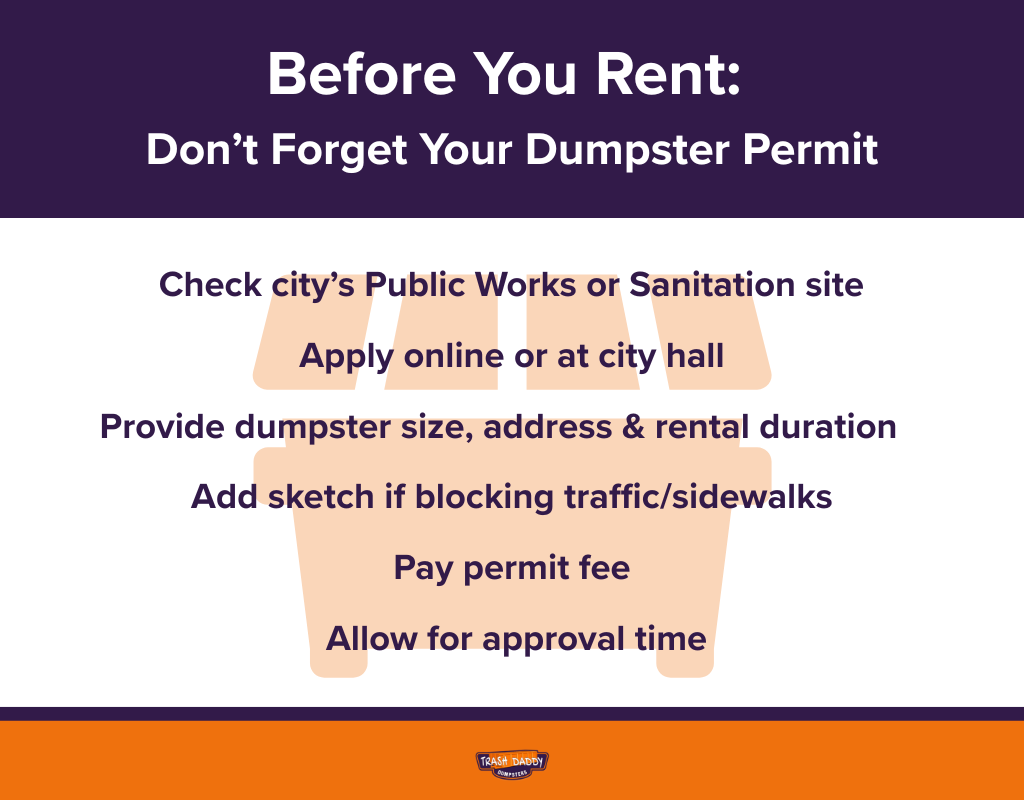
However, in some municipalities—including Boulder, Kansas City, Sacramento, and San Diego—the city requires that you, the customer, obtain the permit directly. In these cases, you'll need to visit your local government's website (usually under the Department of Public Works or Streets and Sanitation) and search for dumpster or street occupancy permits.
The application typically asks for details such as the dumpster size, the address of placement, and how long you expect it to remain there. After completing the form, you'll pay the required permit fee. Approval times vary, so apply early to avoid project delays.
Getting the permit is only half the job, you also need to follow the rules that come with it. Cities often outline placement requirements to make sure dumpsters remain safe and unobtrusive. For example, most municipalities require dumpsters on public property to be clearly marked with reflective tape, barricades, or cones so they’re visible to drivers at night.
Time restrictions are also common. Some cities don’t allow dumpsters to remain on the street overnight or during certain holidays and events. Covering the dumpster with a tarp may be required to prevent loose debris from blowing into the street or storm drains. Municipal waste codes also prohibit hazardous materials such as paints, oils, chemicals, or electronics from being placed in roll-off containers, meaning you’ll need to arrange separate disposal for those items.
By following these compliance rules, you avoid penalties and help maintain a cleaner, safer neighborhood while your project is underway.
Some homeowners and contractors take the risk of skipping permits altogether, but the consequences can be expensive. Cities often issue fines for unpermitted dumpsters, and these can range from small daily penalties to hundreds of dollars depending on the violation. In addition, the city may order the immediate removal of the dumpster, leaving you without a waste solution in the middle of your project.
There’s also the issue of liability. If an accident occurs because of an unpermitted dumpster, for example, a pedestrian trips or a driver’s car is damaged—you could be held legally responsible. Even if you’re not directly at fault, having the dumpster without authorization could weaken your defense.
Ultimately, the small cost and effort of obtaining a dumpster permit are far less than the financial and legal risks of going without one.
To illustrate how much regulations can vary, consider these examples. In New York City, the Department of Transportation requires a permit for any dumpster placed on a street or sidewalk, with fees typically starting around $20 per day. Chicago’s Department of Streets and Sanitation manages dumpster permits there, and costs usually range between $100 and $300 depending on the container size and placement location. However, if a dumpster needs to be placed on a metered street (usually busy streets in downtown metros), sometimes the city will charge a hefty price - often exceeding $500 or even $1000. It depends on how long the dumpster occupies those parking spaces, but the city essentially is making up the revenue lost from the meters by the permit fees. These more expensive permits are rare and only apply in certain situations in certain specific locations.
In Los Angeles, the Bureau of Street Services oversees dumpster regulations, and containers placed in public rights-of-way often require additional safety measures, such as traffic cones or warning signs. Smaller municipalities may not be as strict, with some simply asking residents to call the Department of Public Works for approval, or even allowing driveways to serve as exempt placement zones without any permit at all.
These examples make it clear why it’s so important to check with your local government before ordering a dumpster.
Do I need a dumpster permit for my driveway?
In most cases, no, but some HOAs may require approval.
How long does it take to get a dumpster permit?
It can be same-day in some cities, but larger municipalities may take up to a week.
What happens if I don’t get a permit?
You could face fines, legal liability, and even removal of the dumpster.
Can contractors apply for permits on behalf of homeowners?
Yes, and many dumpster rental companies handle this process for you.
Are permit fees included in dumpster rental prices?
Not always. Some providers include them, while others charge separately.
Renting a dumpster makes cleanup easier, but it also comes with responsibilities. In most areas, you won't need a permit at all, even if the dumpster sits on the street. However, certain cities—particularly larger metropolitan areas like Chicago, Denver, Boulder, Kansas City, Sacramento, and San Diego—do enforce permit requirements for street placement.
If you're unsure whether your city requires a permit, reach out to your dumpster rental company. Many providers are familiar with local permitting processes and will either handle the permit for you (often included in the rental price) or guide you through obtaining it yourself if your city requires the customer to apply directly. If you live in an HOA community, check with them as well, since they may have their own approval requirements separate from city regulations.
By understanding your local requirements and following placement rules, you'll avoid fines, stay on schedule, and keep your project moving forward without unnecessary stress.