



Renovation projects, from minor remodels to major overhauls, inherently generate significant waste. Mismanaging renovation dumpster timing can lead to costly delays, unexpected fees, and even serious compliance issues that threaten both your budget and project timeline. This comprehensive guide provides a strategic framework for optimal dumpster timing, ensuring efficient project debris scheduling and seamless renovation waste planning. By partnering with our firm, you gain access to unparalleled expertise, achieving guaranteed compliance, significant cost savings, and a level of convenience throughout your project that simplifies the entire waste management process.
The thrill of a renovation - the promise of new spaces, modern aesthetics, and enhanced functionality - is often accompanied by an unspoken dread: the mountain of debris it leaves behind. From torn-out drywall and splintered lumber to old fixtures and packaging, managing renovation waste can quickly transform excitement into frustration. Many homeowners and contractors underestimate the complexities of waste disposal, leading to overflowing bins, unexpected delays, and the risk of non-compliance fines. Without a strategic approach to renovation dumpster timing, you're not just risking a messy site; you're jeopardizing your entire project's efficiency and budget.
This is where expert planning makes all the difference. Our firm stands as your transparent, authoritative partner, committed to guiding you through the intricacies of waste management. We don't just provide dumpsters; we provide peace of mind. By understanding and implementing smart renovation dumpster timing, you can streamline your project, minimize stress, avoid costly pitfalls, and ensure full compliance with environmental regulations. Let us help you navigate the complexities so you can focus on bringing your renovation vision to life, knowing your waste is handled expertly and responsibly.
A renovation project isn't a singular event, but a series of interconnected phases, each generating distinct types and volumes of waste. Recognizing these phases is the cornerstone of effective renovation dumpster timing and selecting the most appropriate dumpster size for your needs. A strategic approach ensures you have the right container, at the right time, minimizing costs and maximizing site efficiency.
This is typically where the bulk of the heaviest and most voluminous waste originates. Think structural waste, old drywall, flooring, tiles, cabinetry, plumbing fixtures, and non-load-bearing walls. The sheer quantity and weight of these materials often necessitate the largest initial dumpster or a plan for rapid swaps. Misjudging this phase's debris can lead to premature dumpster fills, halting your demolition crew, or incurring costly overage fees. Proactive renovation waste planning dictates having a dumpster on-site before demolition begins.
As the demolition dust settles, the build-back begins. This phase involves new framing lumber, insulation scraps, smaller off-cuts of drywall, and packaging from new materials. While potentially less dense than demolition debris, the volume can still accumulate quickly. The type of debris here is typically mixed construction and demolition (C&D) waste. Efficient project debris scheduling during this phase focuses on consistent removal to maintain a clear, safe workspace and prevent materials from piling up.
The final stages of a renovation bring forth a different kind of waste. This includes packaging materials from new appliances, light fixtures, flooring, and cabinetry, along with smaller trim pieces, paint cans (empty and dried), and general cleanup items. While individual items might be lighter, the cumulative volume can still be substantial. Depending on the scale, this phase might warrant a smaller dumpster or more frequent pickups of a standard size. Meticulous optimal dumpster timing here supports a clean, professional finish.
Choosing the right dumpster size is paramount to cost-efficiency and compliance. An underestimated size leads to costly premature fills, requiring additional hauls or rentals. An overestimated size means you pay for unused capacity. Here's a general guide:
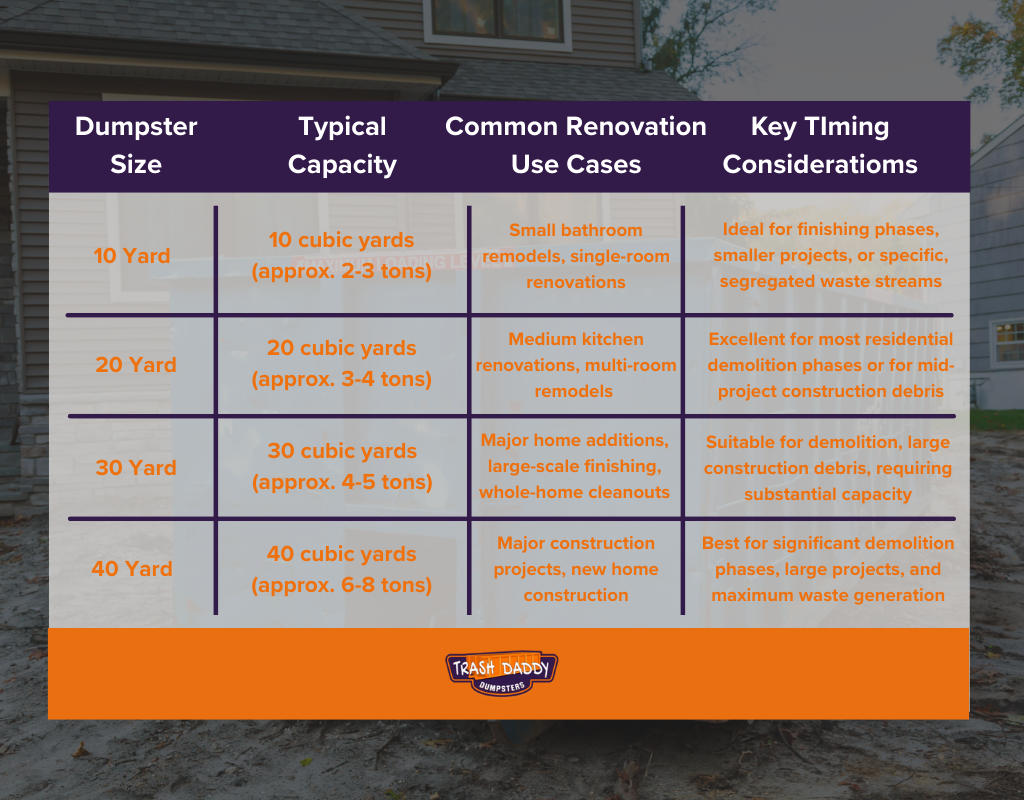
By understanding the unique waste profile of each renovation phase, you can strategically plan your renovation dumpster timing and select the perfect container, optimizing both logistics and budget.
The total cost of your dumpster rental extends far beyond the quoted base price. Effective renovation dumpster timing is a powerful lever that directly influences these additional factors, allowing you to avoid unnecessary expenses and keep your project on budget. Ignoring these elements can lead to unwelcome financial surprises.
Dumpster rentals come with a standard rental period, often 7-10 days. Poor project debris scheduling—whether it's underestimating the time needed or experiencing project delays—can lead to costly extensions. Similarly, every dumpster has a tonnage limit. Exceeding this limit results in incurring costly overage fees, which can add up quickly. Accurate estimation during your renovation waste planning phase is crucial to prevent premature fills and ensure your dumpster is picked up within the allotted time, or proactively scheduling an extension.
Landfill and recycling facilities charge varying rates based on the type of material. Clean concrete, for instance, might be accepted at a lower rate for recycling than mixed construction debris or general waste. Some materials may even have specific environmental surcharges. By strategically timing your waste disposal (e.g., demolishing and disposing of all clean heavy materials like concrete first, then moving to mixed C&D), you can potentially optimize disposal costs. Understanding these classifications is key, and our experts can guide you.
Last-minute decisions or unexpected project accelerations can force a need for immediate dumpster delivery or pickup. While we strive for flexibility, expedited services often come with additional fees. Prioritizing optimal dumpster timing by planning your deliveries and pickups well in advance ensures availability and helps you avoid these charges, contributing to a smoother, more predictable budget.
The physical placement of your dumpster on the job site is a critical logistical detail influenced by the renovation phase. During demolition, a dumpster close to the work area maximizes efficiency. However, as the project progresses, equipment might need to occupy that space. Difficult access, tight turns, or obstacles can increase delivery and pickup times, potentially leading to additional charges. Planning your site layout in conjunction with your renovation dumpster timing ensures clear pathways and suitable placement throughout your project's duration.
Beyond logistical and financial considerations, ensuring your renovation waste management adheres to local, state, and federal regulations is paramount. Failure to comply can result in hefty fines, project stoppages, and significant liability. This is where our deep expertise becomes an invaluable asset, safeguarding your project from preventable risks and establishing us as the most reliable, compliant partner.

Understanding waste classification is fundamental to compliant and cost-effective disposal. Mixing certain materials, particularly hazardous waste with general construction debris, is strictly prohibited and carries severe penalties.
Properly classifying your waste streams as part of your renovation waste planning helps determine the appropriate disposal method, which in turn informs your renovation dumpster timing.
To prevent fines, environmental damage, and operational issues, the following materials are strictly prohibited from standard roll-off dumpsters:
Understanding this list before your renovation begins is critical to avoiding liability and ensuring smooth project debris scheduling.
A common oversight in renovation waste planning is the requirement for permits. If your dumpster needs to be placed on public property, such as a street, sidewalk, or alleyway, a permit from your local municipality is almost certainly required.
Our team can offer general guidance, but it is always the responsibility of the renter to verify and secure specific jurisdictional rules and permits well in advance of their planned renovation dumpster timing.
We understand that waste management is just one piece of your renovation puzzle. Our streamlined, customer-centric booking process is designed to integrate seamlessly with your project timeline, minimizing your effort and maximizing efficiency. We ensure that your renovation dumpster timing is executed flawlessly, from initial consultation to final disposal.
Don't guess; consult an expert. Our knowledgeable team begins by discussing your specific renovation project. We'll delve into the scope, anticipated phases, estimated types and volumes of debris, and your desired project timeline. Based on this, we'll recommend the ideal dumpster size, quantity, and the most strategic optimal dumpster timing for delivery and potential swaps, ensuring you have the right solution for each stage of your renovation. This proactive planning prevents costly missteps down the line.
Once the right solution is determined, we work with you to schedule your dumpster delivery and pickup at times that align perfectly with your project debris scheduling. We confirm placement details, ensuring the drop-off location is safe, accessible, and compliant with any local permits. Our goal is to make the logistics effortless on your end, allowing you to focus on your renovation work without interruption. We pride ourselves on punctuality and precise execution.
When your dumpster is full, or your rental period concludes, simply notify us. Our team will promptly arrange for its pickup. You can trust that all collected materials will be transported and disposed of in full compliance with all environmental regulations. We prioritize responsible waste management, ensuring that your renovation debris is handled ethically and efficiently. We provide transparent communication throughout, so you're always informed about the status of your waste disposal.
Navigating the nuances of renovation dumpster timing can raise several specific questions. Here, we address some common complex queries to further demonstrate our expertise and commitment to customer empowerment.
How far in advance should I schedule my dumpster for a major renovation, especially during peak seasons?
For major renovations, particularly during peak construction seasons (typically spring through fall), we strongly recommend booking your dumpster at least 1-2 weeks in advance. For very large projects or if specific placement requirements (like street permits) are involved, 3-4 weeks' notice is advisable. This ensures availability of your preferred dumpster size and allows ample time to secure any necessary permits, avoiding potential delays and costly rush fees that can arise from last-minute requests. Proactive renovation dumpster timing is key to a smooth start.
What happens if my renovation project runs longer or shorter than anticipated, impacting my planned dumpster rental duration?
We understand that renovation timelines can be fluid. We offer flexible options for adjusting your rental duration. If your project finishes early, you can request an expedited pickup. If delays occur, extensions can typically be arranged for a daily pro-rated fee, subject to availability. The most important step is to communicate with us as soon as your schedule changes. Early notification allows us to adjust our project debris scheduling to best accommodate your new timeline, minimizing any additional costs or inconveniences.
Can I schedule multiple dumpster swaps or different-sized dumpsters for various phases of my renovation?
Absolutely. This is a common and often highly efficient strategy for managing waste in multi-phase renovations, directly leveraging optimal dumpster timing. Many clients find it beneficial to use a larger dumpster for the initial demolition phase, followed by a smaller one for subsequent construction and finishing work. We can coordinate multiple dumpster deliveries, pickups, and swaps to align precisely with your project's progression, ensuring you always have the appropriate capacity and maintain a clean worksite. Our expert consultation (Step 1) helps map out this phased waste management plan.
What are the specific considerations for dumpster placement on my property during different renovation stages to ensure safety and accessibility?
Dumpster placement is critical for both safety and efficiency, and it may change with your renovation dumpster timing. During demolition, proximity to the house or work area is key, but consider stable ground (avoiding soft lawns or septic fields) and clear overhead access (no low-hanging wires or branches). As construction progresses, you might need to shift the dumpster to accommodate material deliveries or equipment. Ensure there's enough clear space for the delivery truck to maneuver safely, and that the dumpster doesn't block essential access points or create tripping hazards. We recommend a flat, hard surface like a driveway, verifying sufficient vertical clearance and proximity to where debris will be generated, always keeping public safety and accessibility in mind.
A successful renovation isn't just about beautiful finishes; it's about seamless execution, cost control, and strict compliance. Strategic renovation dumpster timing is paramount to achieving these objectives, transforming waste management from a potential headache into a streamlined process. By understanding your project phases, anticipating cost factors, and meticulously adhering to environmental and permitting regulations, you lay the groundwork for a stress-free experience.
Choosing an expert provider who understands the nuances of renovation waste planning and logistics is not merely a convenience; it's a strategic advantage. Our commitment to transparent pricing, guaranteed compliance, and unparalleled customer service ensures that your renovation waste is handled with the utmost professionalism and efficiency.
Stop guessing about waste disposal for your next renovation. Secure the right size, guaranteed compliance, and transparent pricing with strategic renovation dumpster timing expertise. Contact us now for a rapid, accurate quote and expert consultation tailored to your project's unique needs!